The word “injured” means a person who receives injury and the both the words are also multi meaning s and have many definitions; some of them are given below:
Merriam Webster Dictionary defines injured as under:
Transitive verb
1
A: to do an injustice to: wrong
B: to harm, impair, or tarnish the standing of <injured his reputation>
C: to give pain to <injure a person’s pride>
2
A: to inflict bodily hurt on
B: to impair the soundness of <injured her health>
C: to inflict material damage or loss on

Examples of INJURE
She fell and injured herself.
She fell and slightly injured her arm.
Several people were badly injured in the accident.
Origin of INJURE
Middle English enjuren, from Anglo-French *enjurer, from Late Latin injuriare, from Latin injuria injury
First Known Use: 15th century
Definition according to Wikipedia, the free encyclopedia
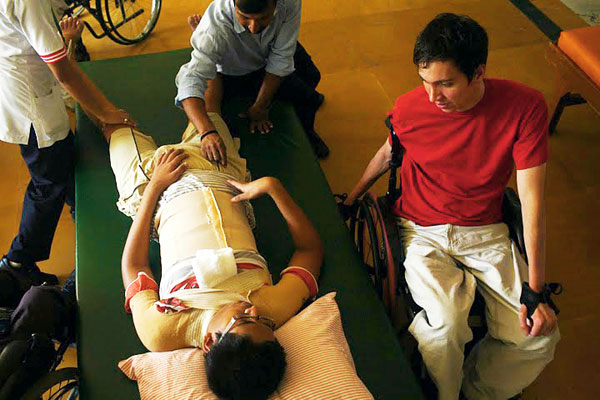
Injury is damage to a biological organism which can be classified on various bases.
1 Classification
1.1 By cause
1.2 By location
1.3 By activity
By cause
Traumatic injury, a body wound or shock produced by sudden physical injury, as from violence or accident
Other injuries from external physical causes, such as radiation injury, burn injury or frostbite
Injury from infection
Injury from toxin or as adverse effect of a pharmaceutical drug
Metabolic injury
Complications of diabetes due to hyperglycemia
Complications of lysosomal and glycogen storage diseases
Injury due to autoimmunity
Injury due to cancer
Injury secondary to any other disease

By location
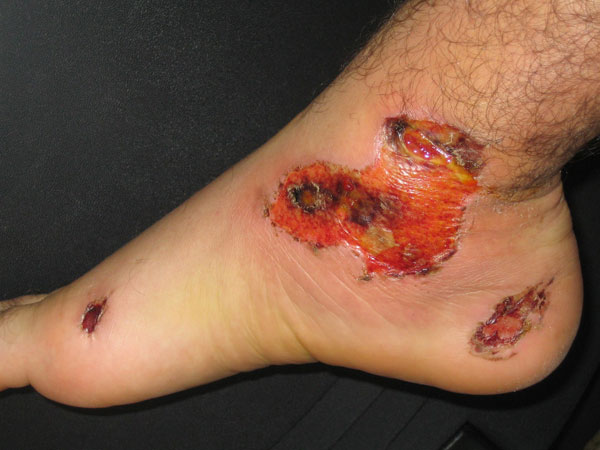
Wound, an injury in which skin is torn, cut or punctured (an open wound), or where blunt force trauma causes a contusion (a closed wound). In pathology, it specifically refers to a sharp injury which damages the dermis of the skin.
Brain injury
Spinal cord injury
Nerve injury
Soft tissue injury
Cell damage, including direct DNA damage
By activity
Sports injury
Occupational injury
The Legal Definition of an Injury
Personal injury law forms a part of the sector of the American legal system devoted to tort law, under which citizens can file lawsuits against each other for the remedying of misdeeds and the recovering of damages. This legal instrument addresses a wider category of harm than is described by the common definition of injury as physical harm, and does not require that the claimant show that he or she suffered any actual wounds.

Psychological harm is also covered under personal injury law, which is designed and implemented throughout the country to ease the financial burden of medical care and lost hours of work, as well as the general satisfaction of some kind of restitution.
For the purposes of civil injury law, the definition given of injuries is not geared toward the stringency required for criminal prosecution, under which direct culpability for an injury would have to be established to a degree sufficient for imposing jail terms and other significant infringements of liberty.

Most commonly, injuries which are tried in court through a tort involve the negligence of the defendant, who is claimed to be responsible for the specific action or the general conditions which led to the claimant being injured. The person who has suffered the injury and his or her legal representative must show that the individual or entity being sued had an obligation to provide for the safety and well-being of others which was not honored and which therefore led to the injury being addressed in the case.
Injury law may define emotional and psychological distress as a form of injury for which legal redress can be sought if, for one thing, an occurrence of physical distress was associated with the mental harm, albeit not experienced directly by the claimant. For instance, a person who closely escaped from suffering physical trauma might be able to claim that any subsequent emotional trauma stemmed from the same source and could therefore be attributed to the individual responsible for the physical danger.

Similarly, the witness of physical trauma being suffered could claim to have suffered from mental harm under personal injury law. Emotional and physical injury may also be found to be present and accordingly used as the basis for a lawsuit in the same case, if the latter can be shown to have caused the former.
In addition to including mental as well as physical suffering, the definition given by personal injury law of its area of interest also may exclude certain forms of physical injury. For instance, a relatively minor form of injury which did not impose any financial requirements on the affected individual, either in the form of missed employment or medical bills, may be excluded from the particular understanding of injury held under personal injury law.
Personal injury law may be applied to either the actual person claimed to be responsible for the injury or to the defendant’s insurance carrier, who will then be required to pay for the medical bills of the personal injury claimant.
Definition of injured according to the legal dictionary
Tort Law
A body of rights, obligations, and remedies that is applied by courts in civil proceedings to provide relief for persons who have suffered harm from the wrongful acts of others. The person who sustains injury or suffers pecuniary damage as the result of tortious conduct is known as the plaintiff, and the person who is responsible for inflicting the injury and incurs liability for the damage is known as the defendant or tortfeasor.
Three elements must be established in every tort action. First, the plaintiff must establish that the defendant was under a legal duty to act in a particular fashion. Second, the plaintiff must demonstrate that the defendant breached this duty by failing to conform to his or her behavior accordingly. Third, the plaintiff must prove that he suffered injury or loss as a direct result of the defendant’s breach.
Civil Law
In the technical sense of the term it is a delict committed in contempt, or outrage of any one, whereby his body, his dignity, or his reputation, is maliciously injured.
2. Injuries may be divided into two classes, With reference to the means used by the wrong doer, namely, by words and by acts. The first are called verbal injuries, the latter real.
3. A verbal injury, when directed against a private person, consists in the uttering contumelious words, which tend to expose his character, by making him little or ridiculous. Where the offensive words are uttered in the beat of a dispute, and spoken to the person’s face, the law does not presume any malicious intention in the utterer, whose resentment generally subsides with his passion;, and yet, even in that case, the truth of the injurious words seldom absolves entirely from punishment. Where the injurious expressions have a tendency to blacken one’s moral character, or fix some particular guilt upon him, and are deliberately repeated in different companies, or banded about in whispers to confidants, it then grows up to the crime of slander, agreeably to the distinction of the Roman law.
4. A reat injury is inflicted by any fact by which a person’s honor or dignity is affected; as striking one with a cane, or even aiming a blow without striking; spitting in one’s face; assuming a coat of arms, or any other mark of distinction proper to another, &c. The composing and publish in defamatory libels maybe reckoned of this kind.
Criminal law/Civil Law
Criminal law, the branch of law that defines crimes, treats of their nature, and provides for their punishment. A tort is a civil wrong committed against an individual; a crime, on the other hand, is regarded as an offense committed against the public, even though only one individual may have been wronged. The real distinction lies in the way a remedy for the wrong is pursued. A tort is a wrong for which the remedy is pursued by, and at the discretion of, the injured individual or his or her representative, while a crime is a wrong for which the wrongdoer is prosecuted by the state for the purpose of punishment. However, the fact that a particular act has been or may be prosecuted as a crime does not necessarily preclude an injured party from seeking recovery from the offender in a civil action.
According to Pakistan Penal Code
In the Pakistan Penal Code the word hurt is used in place of injury which have almostly the same meaning.
332 Hurt:
(1) Whoever causes pain, harm, disease, infianity or injury to any person or impairs, disables or dismembers any organ of the body or part thereof of any person without causing his death, is said to cause hurt.
(2) The following are the kinds of hurt:
(a) Itlaf-i-udw
(b) Itlaf-i-salahiyyat-i-udw
(c) shajjah
(d) jurh and
(e) All kinds of other hurts.
There are many types of injuries under the Civil Law, Law of Tort, Criminal Law and the Penal Law i.e. to do an injustice, to do wrong, to harm, to impair, to harm the reputation, to inflict bodily hurt, to impair the soundness of health, to inflict material damage or loss, to injure through radiation, burn or bite frost, infection, toxin or as adverse effect of a pharmaceutical drug, metabolic, complications of diabetes or lysosomal and glycogen storage diseases, autoimmunity, cancer, to hurt brain and spinal cord of any person. Injury may be as a result of explosion, accident and firing. Injury may be with a blunt or sharp weapons and fire arm. However, in case of injuries under the Civil Law and Law of Tort, only compensation is given while the injuries under the Criminal Law or Penal Law may be punished with prison and fine etc.


