Archive : Akbar

RSS feed

Sweet And Interesting Languages of Pakistan

Pakistani Languages:

Languages spoken in Pakistan belong to the family of Indo-Iranian range.
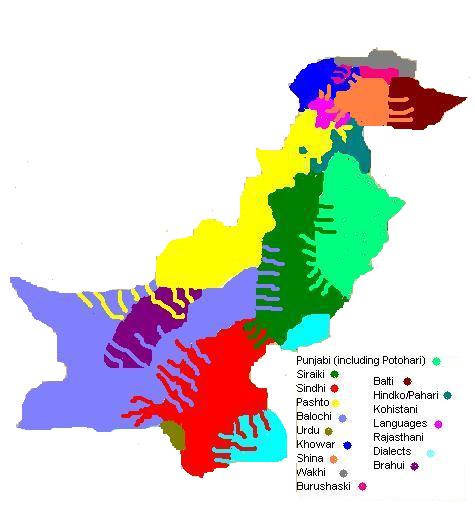
Pakistan Language map

Urdu:
Urdu has historical significance because Urdu developed during the Islamic and Mughal Empire in the Indian Subcontinent. During that period Urdu was chosen as a neutral language to unite the different communities of Indian Subcontinent. Urdu gained prestige and patronage at Muslim courts and developed into a literary language. Urdu is the national language of Pakistan. It is closely related to Hindi but is written in an extended Arabic alphabet. Urdu has accepted many words from Arabic and Persian and Turkish.

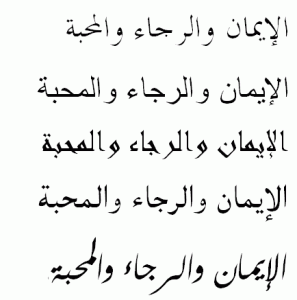
Urdu Alphabet

Arabic and Persian:
Persian is widely spoken in Pakistan. It has a million speakers including refugees from Afghanistan (mainly from Tajiks and Hazaras). Both the languages are still taught as classical languages to a small number of students mainly in Madrassas. Arabic is popular due to its religious significance. Persian is an important literary language in Pakistan.
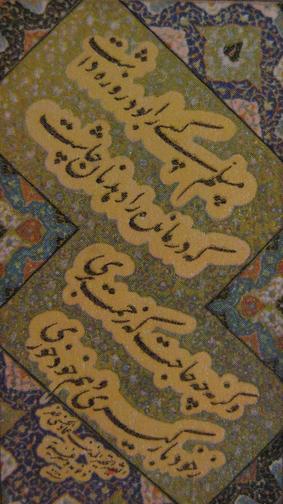
persion
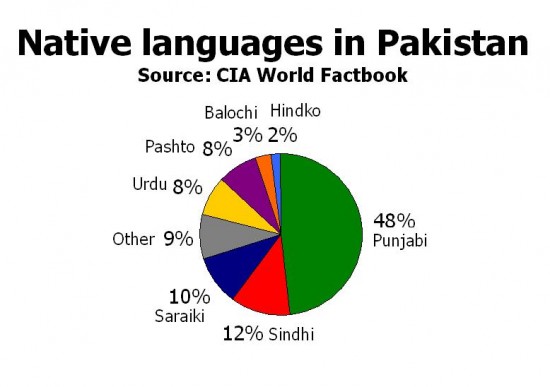
According to the census, Mother tongues of Pakistanis are the following languages : Punjabi 44%, Pashto 15%, Sindhi 14%, Seraiki 11%, Urdu 8%, Balochi 4%, others 4%

The majority of Pakistanis can speak or understand two or more languages.
Major languages:
The official language of Pakistan is English. Pakistan’s Constitution and laws are written in English. Many schools, and nearly all colleges and universities, use English as the medium of instruction. Urdu is the national language and it has been promoted as a token of national unity. 44% speak Punjabi as a first language, 15% Pashto, and 31% other languages such as (Sindhi, Seraiki, Balochi, Hindko spoken in northern Pakistan and Azad Kashmir also Mirpuri (AJK), and Brahui.)

Punjabi:
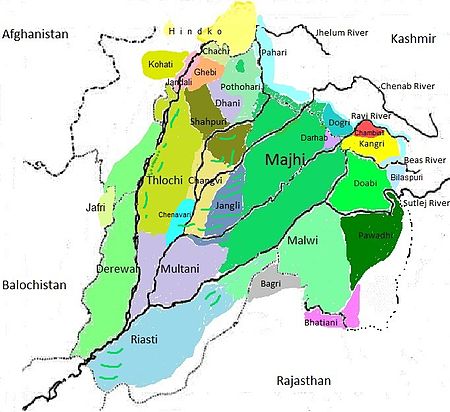
Punjabi is spoken as a first language by 44% of Pakistanis, mostly in Punjab as well as by a large number of people in Karachi and in whole Pakistan. It is an important language and it is spoken by about half of Pakistanis. Punjabi does not have official status in Punjab or in Pakistan. Punjabi is spoken by almost 60% of the population in Pakistan. The standardized Punjabi dialects is from Lahore, Sialkot, Gujranwala and Sheikhupura districts of the Pakistani Punjab. Punjabi is also now days language of Punjabi literature, film and music. Other dialects are Multani or Siraiki in West and South, Pothowari in North, Dogri in the mountain areas and Shahpuri in Sargodha area.
Pashto:
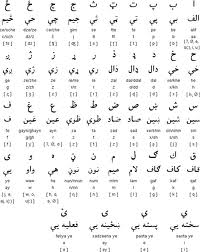
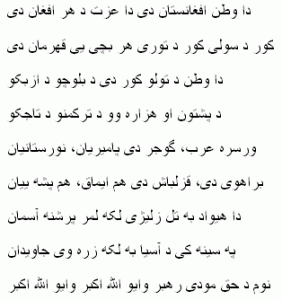
Pashto is spoken as a mother tongue by 15% of Pakistanis, mostly in the North-West Frontier Province, Federally Administered Tribal Areas and in Baluchistan as well as by Afghan refugees. Pashto has two major dialect patterns; these are Pakhto, which is the northern (Peshawar) variety, and the softer Pashto spoken in southern areas. Khushal Khan Khatak (1613-1689) and Rehman Baba (1633-1708) were some big poets in Pashto language.
Sindhi:
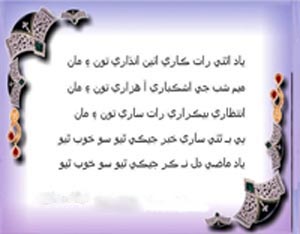
Sindhi is spoken as a first language by 14% of Pakistanis, in Sind and in parts of Baluchistan. Sindhi has very rich literature and is used as a literary language in schools. Sindhi language contains Arabic words and is written in extended Arabic alphabet with several additional letters to accommodate special sounds. Sindhi is spoken by about 20 million people in the southern Pakistani province of Sind, Southern Pakistan. The largest Sindhi-speaking city in Pakistan is Hyderabad. Shah Abdul Latif Bhattai (1689-1752) was one of its legendry poet of Sindhi literature who wrote Sassi Punnu, Umar Marwi in his famous book “Shah jo Rasalo”.
Baluchi:
4% of Pakistanis, mostly in Baluchistan, Sind and southern Punjab speak Baluchi language. Baluchi language is very close to the Persian language itself. A series of migrations from Northern Iran, near the Caspian Shores brought the language to its present location. Rakshani is the major dialect group in Baluchistan.

Seraiki:
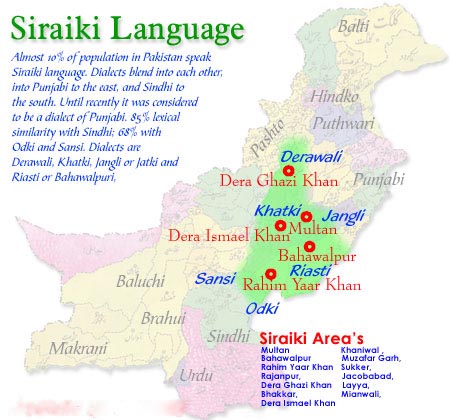
Seraiki is related to Punjabi and Sindhi and it is spoken by 11% of Pakistanis, mostly in southern districts of Punjab as a mother tongue. Dialects tend to blend into each other, into Punjabi to the east, and Sindhi to the south. Seraiki has 85% lexical similarity with Sindhi; 68% with Odki and Sansi. Dialects are Derawali, Thalochi, Khatki, Jangli or Jatki and Riasti or Bahawalpuri.


Kashmiri:
There is a large Kashmiri speaking population in Pakistan, largely refugees as well who fled from the Vale of Kashmir. Mirpuri-Hindko, Pashto, Urdu Languages are spoken in Azad Kashmir region.

Gujarati:
100,000 Pakistanis who are resident in Lower Punjab and Sind speak Gujrati language. Gujrati Is Spoken by Parsi (5,000), many Ismaili Muslims, and many Hindus (10,000 to 100,000).

Other languages:
Numerous other languages are spoken by relatively small numbers of people, especially in the isolated places for example, the Northern Areas of Pakistan. Such as Burshaski is Spoken in Hunza and Shina is spoken in Baltistan , Khowar is Spoken is Chitral and Kalash is spoken in the Kalash Valley.
Filed in: Akbar
1

10 Most Weirdest Places to Live

Living in a Billboard:

It is a wonderful recycling process. Expired billboards in a perfectly good  conditions  can be reuse as a living space. Many of us don’t know about those void billboards, that would make a good one bedroom apartment. Now a days, we see that this extraordinary idea comes into a  practical use.

Living in a Billboard

Living in a Walking House:

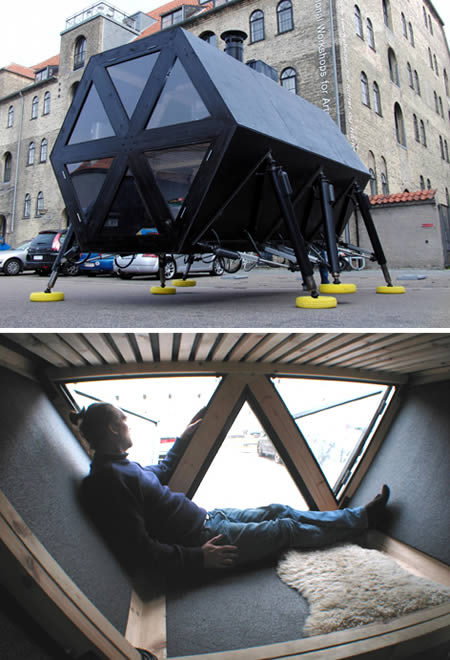
Walking House is a movable housing system that enables residents to live a peaceful nomadic life near the natural life in ecosystem. It is basically an energy conservation system, which can use and recollect solar, wind and hydroelectric energy.

Living in a Walking House (more…)

Filed in: Akbar
0

English Sentence Structures By The Interchange Of Active Voice And Passive Voice

Active Voice And Passive Voice

Active voice is a grammatical voice common in many of the world’s languages. Active voice is used in a clause whose subject expresses the agent of the main verb. That is, the subject does the action designated by the verb. A sentence whose agent is marked as grammatical subject is called an active sentence. In contrast, a sentence in which the subject has the role of patient or theme is called a passive sentence, and its verb is expressed in passive voice. Many languages have both an active and a passive voice; this allows for greater flexibility in sentence construction, as either the semantic agent or patient may take the syntactic role of subject.

Active voice:

In most English sentences with an action verb, the subject performs the action denoted by the verb.

These examples show that the subject is doing the verb’s action.

Passive voice:

One can change the normal word order of many active sentences (those with a direct object) so that the subject is no longer active, but is, instead, being acted upon by the verb – or passive.

Note in these examples how the subject-verb relationship has changed.
Active Versus Passive Voice
[ENGLISH SENTENCE STRUCTURES]
Subject + transitive verb + object

Active Voice – - John teaches Paul.
Passive Voice – Paul is taught by John.

Active Voice – People say/ They say/ Everybody says.
Passive Voice – It is said (by people/ by them/ by everybody)

Active Voice – Joseph bashed Morris.
Passive Voice – Morris was bashed by Joseph.

Active Voice – The audience loudly cheered the Mayor’s speech.
Passive Voice – The Mayor’s speech was loudly cheered.

Active Voice – Police personnel were taking him to prison.
Passive Voice – He was being taken to prison by police personnel.

Active Voice – People (They) will help me. Or Someone will help me.
Passive Voice – I will be helped.

Active Voice – Circumstances will oblige me to go.
Passive Voice – I shall be obliged to go.

Active Voice – The students will make him monitor.
Passive Voice – He will be made monitor by the students.

[ENGLISH SENTENCE STRUCTURES]
Subject + verb ‘to be’ + Infinitive
(Subject + am/is/are/was/were + infinitive (to + verb)

Active Voice – I am to help him.
Passive Voice – He is to be helped.

Active Voice – They were to bring doctor.
Passive Voice – Doctor was to be brought.

Active Voice – She is to take the baby away.
Passive Voice – The baby is to be taken away.

[ENGLISH SENTENCE STRUCTURES]
Subject + may/can/should/must/etc. + Infinitive

Active Voice – I can defeat him.
Passive Voice – He can be defeated.

[ENGLISH SENTENCE STRUCTURES]
Subject + verb + preposition + object + (Adverb of manner)

Active Voice – I look after him.
Passive Voice – He is looked after (by me).

Active Voice – I am searching for him.
Passive Voice – He is being searched for (by me).

Active Voice – I will look after you well.
Passive Voice – You will be well-looked after.

Active Voice – All his colleagues laughed at him.
Passive Voice – He was laughed at by all his colleagues.

Note – use of other preposition instead of ‘by’
Active Voice – He satisfied everybody.
Passive Voice – Everybody was satisfied with him.

Active Voice – He knows me.
Passive Voice – I am known to him.

Active Voice – Her conduct shocked me.
Passive Voice – I was shocked at her conduct.

Active Voice – This book has greatly interested me.
Passive Voice – I have been greatly interested in this book.

Active Voice – His manners vex me sometimes.
Passive Voice – I am sometimes vexed at his manners.

[ENGLISH SENTENCE STRUCTURES]
Subject + verb + object + complement

Active Voice – We elected him manager.
Passive Voice – He was elected manager.

Active Voice – Public made him leader.
Passive Voice – He was made leader.

[ENGLISH SENTENCE STRUCTURES]
Subject + verb + object + object

Active Voice – He gave me a book.
Passive Voice – I was given a book. Or
Passive Voice – A book was given to me.

Active Voice – He bought me a laptop.
Passive Voice – A laptop was bought for me. OR
Passive Voice – I was bought a laptop by him.

Active Voice – The Principal gave him an award.
Passive Voice – He was given an award by the principal. OR
Passive Voice – An award was given him by the principal.

Active Voice – The guard refused him admittance.
Passive Voice – Admittance was refused him by the guard. OR
Passive Voice – He was refused admittance by guard.

Active Voice – President offered her a ministerial post.
Passive Voice – A ministerial post was offered her. OR
Passive Voice – She was offered a ministerial post.

Active Voice – He teaches us English grammar.
Passive Voice – English grammar is taught us by him. OR
Passive Voice – We are taught English grammar by him.

Active Voice – The teacher will give you an assignment.
Passive Voice – An assignment will be given you by the teacher. OR
Passive Voice – You will be given an assignment by the teacher.

ENGLISH SENTENCE STRUCTURES]
There + verb + noun (subject) + Infinitive

Active Voice – There is no time to lose.
Passive Voice – There is no time to be lost.

Active Voice – There is no money to waste.
Passive Voice – There is no money to be wasted.

[ENGLISH SENTENCE STRUCTURES]
Subject + verb + object + infinitive (without ‘to’)

Active Voice – He saw me play a game.
Passive Voice – I was seen to play a game.

Active Voice – I found him tease the kid.
Passive Voice – He was found to tease the kid.

[ENGLISH SENTENCE STRUCTURES]
Interrogative Sentences

(i) Interrogative Sentences with auxiliary

Active Voice – Did she pay you?
Passive Voice – Were you paid by he?

Active Voice – Will he develop a website?
Passive Voice – Will a website be developed by him?

Active Voice – Has he written a script?
Passive Voice – Has a script been written by him?

(ii) Interrogative Sentences with ‘who’

Active Voice – Who present you this book?
Passive Voice – By whom was this book presented to you? OR
Passive Voice – By whom were you presented this book? OR
Passive Voice – Who was this book presented to you by?

Active Voice – Who can keep this money?
Passive Voice – By whom can this money be kept? OR
Passive Voice – Who can this money be kept by?

Active Voice – Who gave you computer?
Passive Voice – By whom was computer given you? OR
Passive Voice – By whom were you given computer? OR
Passive Voice – Who was computer given to you by?

(iii) Interrogative Sentences: Indirect question

Active Voice – I asked Martina if she was ill.
Passive Voice – Martina was asked if she was ill.

Active Voice – I asked her when she would revisit.
Passive Voice – She was asked when she would revisit.

Filed in: Akbar
1

Investment Opportunities In Livestock Sector In Pakistan

Livestock is the most important sub-sector of agriculture in Pakistan. Livestock sector has share of  10.8 percent contribution of national GDP and share of 46.8 per cent to the agriculture value added. This sector also contributes a big share towards national exports and according to surveys almost 8.5 – 9.0 per cent of national exports belong to the livestock. Livestock provides raw material to the national industry. Livestock  sector is also responsible for creating market and capital.  People from the rural areas highly depend upon livestock, as they can cash it at the time of their need so this sector also works as a social security for the poor from rural areas.  In Barani areas livestock is the main chief source of income, and works as a security for them.

Livestock sector:

According to the latest surveys,  24.9 million sheep, 26.3 million buffaloes, 24.2 million cattle 24.9 million sheep, 56.7 million goats and 0.8 million camel make the national herd. There is a Vigorous and animated poultry sector in the country is also contributing its share in livestock. Its share has more than 530 million birds production annually. 29.472 million tons of milk has been produced by these livestock. By the contribution of these milk producing livestock, Pakistan  is now 5th largest milk  producer in the world. Livestock sector also shares 1.115 million tons of beef, 0.740 million tons of mutton, 0.416 million tons of poultry meat, 8.528 billion eggs, 40.2 thousand tons of wool, 21.5 thousand tons of hair and 51.2 million skins and hides in the national production of livestock. Different provinces of Pakistan produce different livestock production. The distribution of livestock in different provinces is different such as Buffaloes are main dairy animal and are mainly found in Punjab (60.8 per cent) and Sindh (31.8 per cent). Buffaloes are now making their presence  in other provinces also and in Azad Jammu & Kashmir and even in  Northern Areas. Cattle have traditionally been raised for production of milk and are distributed in approximately according to areas in different provinces. But in Balochistan only 6.4 per cent cattle are present which is the lowest from other provinces. Majority of sheep  harbours  in Baluchistan as this province alone has 44.2 per cent of the sheep population of the country.

Investment opportunities:

Livestock sector is increasing gradually and different factors play the favourable role in inward investments. There is high demand for the livestock product in the domestic level as well as in the export level. Urbanisation and economic development are the two main factors in the increasing demand of livestock product. The current growth ratio in Pakistan for milk is 2.9 per cent and for meat is 3.2 per cent. It is expected That growth rate will beat 3.2 and 4.3 per cent for milk and meat respectively in next five years with modest public sector investment. The demand for milk and meat is projected at least at a growth rate of 5.0 per cent for milk and 6.5 per cent for meat.

Filed in: Akbar
0

Latest Eid Kurta Salwar Designs 2011 For Men

Kurta Shalwar In Pakistan:


The evolution of the salwar kameez or Salwar kameez or Shalwar Qameez has a long and colorful history which originated with the influence of Islamic reign on India. The intermingling of cultures created the trend of wearing loose pajamas and kurtas for men as well as women.

Pakistani clothing including evening wear, casual wear, formal wear shalwar kameez, and modern apparels which are worn usually in Pakistan, India, Bangladesh, all over South Asia and at South Asian families.

Salwar Kameez or Kurta Shalwar is the most popular outfit for South Asian men specially in Pakistan. Shalwar Kameez is extremely comfortable and looks elegant on Men of all age.

Here you can see the top brands of Kurta design in Pakistan for the year 2011. Free Kurta design for boys and youngest for Pakistani boys. Below Pictures Of Kurta Design Of Men’s was taken from the top boutiques in Karachi, Lahore and Islamabad. Below is the collection of Kurta Design for the summer 2011.

Here are a Few Pictures of Latest Collection Of Kurta Shalwar for Men which are into Fashion Nowadays.

Filed in: Akbar
1
© 2011 Social Voting. All rights reserved.